How to Adjust for Altitude When Water-Bath Canning
This post may contain affiliate links. As an Amazon associate, I earn a commission from qualifying purchases.
When it comes to water bath canning, altitude matters. Learn how to adjust your canning recipes to account for elevation so that you can preserve your food safely.
There’s no point in putting endless effort into preserving your food only to have it spoil or be unsafe to eat. Let’s talk about why you need to adjust for elevation when you’re preserving food in a water bath canner, and how to go about doing it so that your canned goods are safe to eat long after they come out of the canner.
Why You Need to Adjust for Elevation
As elevation increases, the air becomes thinner. With less pressure from the air holding water molecules in their liquid state, they are able to boil at a lower temperature, escaping as gas. At sea level, water boils at 212°F (100°C). For every 1000 feet you climb, the boiling point of water drops about 2°F (1°C).
Why does this matter in the home canning world? The canning process is designed to kill any dangerous pathogens in the food, allowing it to be shelf stable for a long period of time. But when the boiling point is lower, the liquid doesn’t reach the same temperature before it starts to boil, so it takes longer to kill off all off those little guys, hence, longer processing time.
How to Adjust Water-Bath Canning Time for Elevation
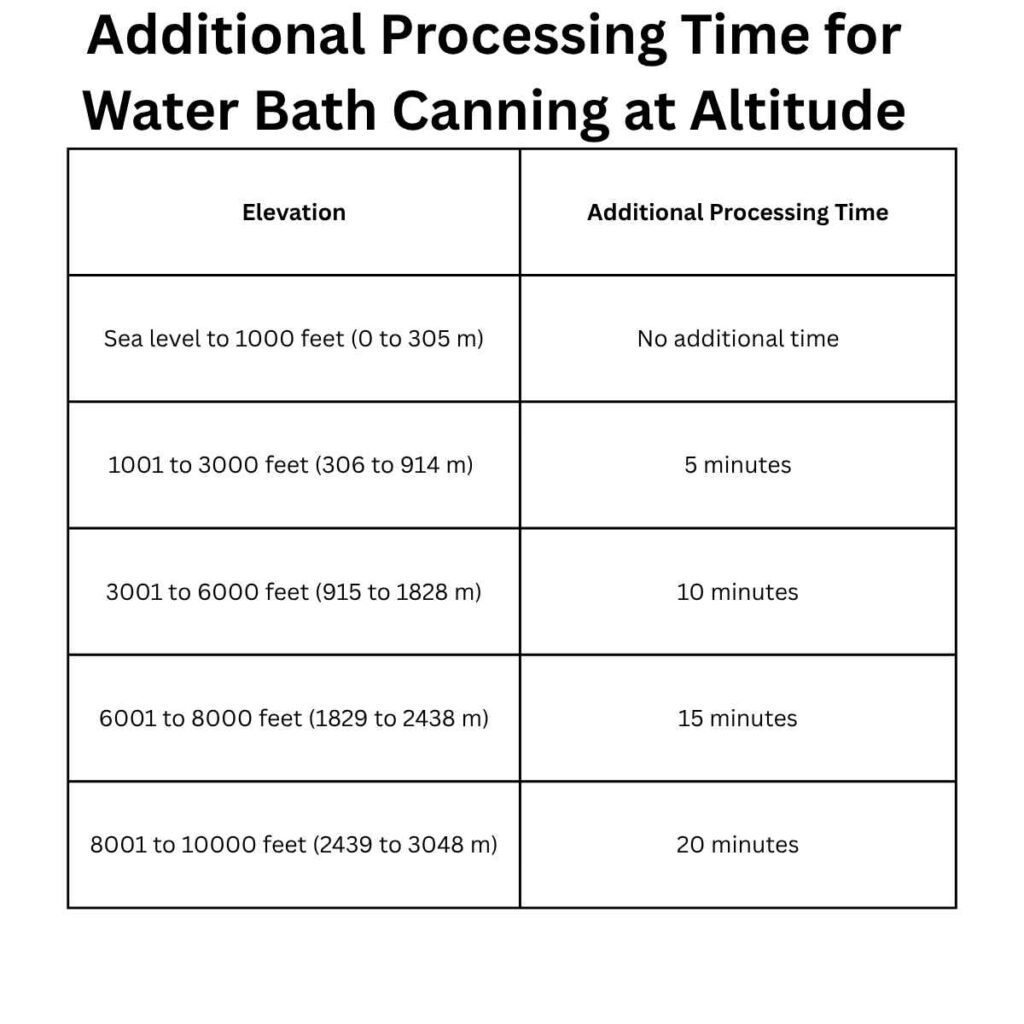
The process is simple. Make note of the altitude where you are canning. This information can be found online for all major cities, or you can use the terrain view in Google Maps to determine your exact location and altitude. Using the chart below cross reference your elevation with the additional processing time. Note that this is the extra time you need to add to the processing time specified in the recipe.
For example, if your rhubarb ginger jam recipe tells you to process for 10 minutes, and you are at 3200 feet above sea level, you need to add an extra 10 minutes of time to the original time, so you’ll be processing your jam for 20 minutes total. At that point, your preserves will be safe to store at room temperature and enjoy later in the year.